
Cryptospace News Digest, May 22 – June 4
While crypto-kickstarter Waves becomes the sixth most successfully crowdfunded project ever, and Russian authorities go mad about blockchain technology, Bitcoin keeps on breaking records. That’s what this week was about.
Bitcoin Price
Bitcoin price is upwards. If only a week ago, on May 29, the price surpassed $500 and even peaked at $553 for a short while, from Monday on, the cryptocurrency was steadily traded around $530-540 using the previous price of nearly $520-525 as its support.
On Friday morning, Bitcoin price surged once again by growing up to $550 in less than an hour, and even peaking at $574. However, it wasn’t the limit. On Saturday, Bitcoin exchange rate went even farther and consolidated at around $578 after peaking at $590 for a short while. According to Coinmarketcap data, it’s the first time anything like this happening since August 2014.
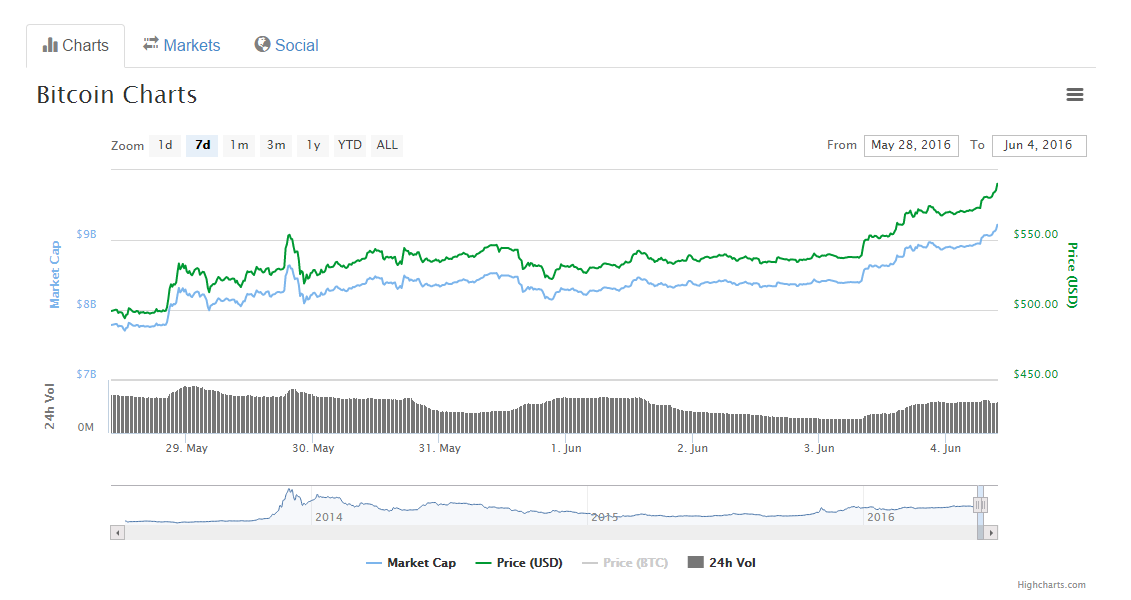
Analysts and media sources have largely attributed this sharp increase to demand from the Chinese market, prompted by yuan devaluation.
Bobby Lee of BTCC said:
“People are worrying about the PBOC (People’s Bank of China) devaluing the yuan,” BTCC’s Bobby Lee said from Hong Kong. “If you’re in China and you’re holding onto that yuan, that’s a huge risk, so they’re buying into hard assets … Bitcoin is something that is very easily traded into, so that’s what’s happening.”
Meanwhile in the Ethereum world, ETH began growing once again, and on May 31 gained $0.90 in one go (from $13.05 to $13.95) peaking at around $14.39 at Kraken and $14.30 at Bitfinex.
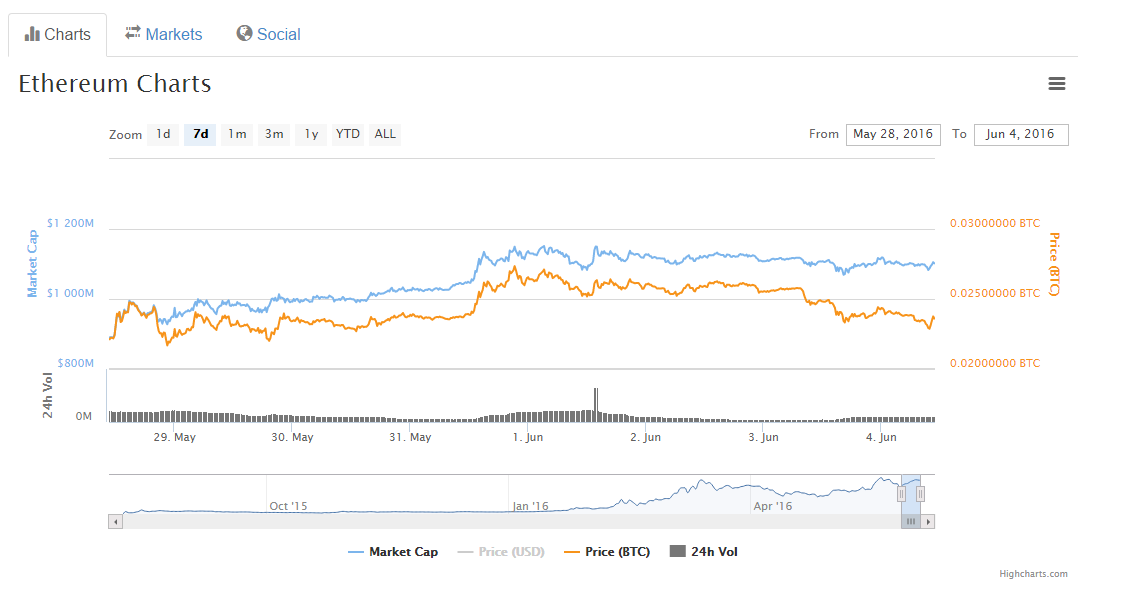
On June 4, ETH tokens traded at around $13.75, which is only 0.34$ lower than a week ago.
Bitstamp, GDAX, PayPal and Australia
On May 30, Bitstamp has announced expansion of its Bitcoin service for credit/debit cards across all member states of the EU. Those willing to use the service have to register a card at the exchange and undergo verification. After that, the user will be able to instantly buy up to $1,000 worth of Bitcoins a day.
Instant #bitcoin purchase using credit card now available in 28 EU countries https://t.co/b6H14wA23p pic.twitter.com/RbCJcO2VZd
— Bitstamp (@Bitstamp) May 30, 2016
The exchange has also added BTC/EUR pair, possibly being a bit envious about Kraken’s success.
GDAX, the cryptocurrency exchange formerly known as Coinbase, is also seeking to make Bitcoin purchasesr. On June 2, the company released Coinbase Buy Widget, which, according to the description, is a regular web widget enabling users to instantly buy cryptocurrency with debit cards, and to send the newly bought Bitcoins to the specified wallet address.
The new service will be integrated with Brave browser, as its functionality would make micropayments within the platform way easier. Other partners include Hammercoin (a next generation bitcoin-powered minecraft experience by BitQuest creators) and Popchest (a micropayments platform for video content authors).
Australian Bitcoin exchange Bitcoin.com.au and fintech startup Blueshyft have partnered to enable Bitcoin purchases in more than a thousand of newsstands across Australia. In Indonesia, users of KinerjaPay, a popular local e-commerce platform, will have an option of paying with Bitcoin s thanks to the company’s partnership with local exchange Bitcoin Indonesia. In the U.S., Bitwage, a service offering Bitcoin payroll services, has announced adding the second capitalized cryptocurrency Ethereum as another option.
Meanwhile, PayPal has filed a patent application for a modular payments device capable of operating cryptocurrencies, thus reinforcing its Bitcoin integration direction.
The device will be a modular platform similar to a regular payments terminal. Customers will have to use special cards with virtual wallets. The patent focuses on transaction security enabled by a dedicated payments module set to verify the correspondence of all other modules to those registered in the general database. Thus, any theft or loss of the card/payments terminal would not result in the loss of funds. The device’s concept is somewhat similar to that used in some hardware wallets.
Wallets
Speaking of hardware wallets, last week KeepKey has announced the company is going to integrate Segregated Witness.
“All the new plans for the bitcoin protocol, like Segregated Witness, will be integrated. We’re going to begin working on that immediately,” KeepKey founder and CEO Darin Stanchfield said.
Earlier, the company has acquired one of the first Bitcoin wallets, MultiBit, including its clients, software, website, and other forms of intellectual property.
Amazingly enough, until recently there hasn’t been any multi-currency cryptowallet for iOS. This despicable discrimination of Apple users is now over thanks to the Canadian CryptoKit, which has released an iOS version of its Jaxx wallet. Jaxx has also become the first iOS wallet with Ethereum support. Notwithstanding earlier troubles with the launch, the app is currently up and running at AppStore.
Jaxx iOS is now live! App Store link: https://t.co/l3V13gdKx0 Details: https://t.co/MhyO4mQgbC #Ethereum #Bitcoin pic.twitter.com/7NFueyEOol
— Jaxx (@jaxx_io) May 28, 2016
Security
Kaspersky Lab, a company owned by one of the world’s leaders in antivirus software, has published a report stating that Bitcoin is involved in only 3% of all online scams. The company says nearly 50 percent of all internet users have fallen victims to online scams at least once, with only 11 percent of users losing their money.
Speaking of security, blockchain platform Waves has released a statement warning its users about suspicious operations with Waves tokens running at Yobit exchange, which has been selling the startup’s derivatives prior to their official release.
“We do not recommend to effect any buy/sale operations with Waves coins until the main network is launched to the full extent, and coins have become withdrawable from the personal account,” Waves’ statement reads.
The statement follows the company’s incredibly successful fundraising campaign, which resulted in raising nearly $16 m through crowdsale efforts, making it the second most successfully crowdfunded project ever. In fact, Ethereum’s crowdsale resulted in only $2 m more.
Meanwhile Ernst & Young has announced an auction to sell 24,518 BTC seized from one of Silk Road users. The auction, set to be held in Sydney, is assessed at $12.9 m. One may only guess, is it really Chinese investors influencing Bitcoin’s current price surge, or is it just a company of Bruces inflating the rate before the auction.
Technologies and Investment
On May 31, Microsoft partnered with Blockstack Labs and ConsenSys to create a blockchain-based solution for user identification and data management.
“An implementation of self-sovereign identity can be established using the qualities of blockchain based systems and we have chosen to start collaborating with two partners with considerable blockchain identity expertise. We are working with Blockstack Labs and ConsenSys to leverage their current Bitcoin and Ethereum-based identity solutions, Blockstack and uPort. Through this open source collaboration we intend to produce a cross-chain identity solution that can be extended to any future blockchains or new kinds of decentralized, distributed systems.” Yorke Rhodes, blockchain business strategist at Microsoft, said
New-York based startup Mediachain engaged in development of a metadata protocol enabling content creators to link their data to the created content has raised $1.5m in its latest funding round led by Union Square Ventures and Andreessen Horowitz.
Venture fund Life.Sreda has recently launched a project dubbed Banking on Blockchain Fund (BB Find) to attract investments to blockchain-related startups. According to BB Fund’s managers, the fund will give grants to blockchain projects focused on banking solutions.
Meanwhile South Korean authorities have revealed plans to support blockchain and fintech startups. The Financial Services Commission chairman Yim Jong-Yong stated:
“With the advent of fintech and ICT-based firms, once-exclusive financial services are evolving into new types of services. As capital markets have large potential in innovation and change, the government will make sure that start-ups with creative ideas get enough venture capital”.
The government will also help foster a giant investment bank to invest in venture capitals, Yim Jong-Yong said.
Tech giant Intel has opened a development lab in Tel Aviv focused on financial technologies like the blockchain. The company is working with The Floor, an Israeli FinTech organization. Other technologies that the lab will focus on include connected devices for the Internet of Things (IoT), cloud computing and biometric applications..
“Through this collaboration, Intel will be able to lead, alongside The Floor, the development of this field in Israel and to widen the influence of technology on the financial field, from the user to the cloud,” Sharon Puterman-Zafrir, manager of IoT for Intel’s Israeli division, said in a statement.
Another notable investor in Israeli blockchain industry is Bitmain Technology. Mining equipment manufacturer and Antpool’s operator has funded local blockchain startup ChainLab. The parties opted not to disclose the amount of the investment, however, the Chinese giant is mostly interested in Wings project engaged in development of a DAO.
Additionally, Antpool has added Ethereum mining options, and announced the forthcoming Litecoin mining.
R3CEV
International bank consortium R3CEV headed by fintech startup R3 has published Vitalik Buterin‘s report assessing the potential of using Ethereum in banking.
According to the head of the consortium’s research department Tim Swanson, the report was requested in multiple queries from member banks, which had been interested in Ethereum and smart contracts. The report addresses the confidentiality issues of Ethereum’s smart contracts, as well as questions of the platform’s scalability.
R3CEV has also added Hong Kong-based life insurance group AIA to the ranks of its global banking consortium. The announcement comes at a time when R3 is increasing its presence in Asia as well as diversifying its portfolio of participating financial institutions, having added China-based Ping An Insurance Group to its consortium in late May. According to R3 CEO David Rutter, new members will make a significant contribution in the dialogue between the consortium members.
Russia Unchained and Cryptoeconomics
The week was full of amazing statements on the forthcoming blockchain revolution from Russian officials and managers.
Initially, deputy minister for finance Alexei Moiseev has once again broken forth into restrictive eloquence when speaking about the forthcoming revision of a bill prohibiting Bitcoin in Russia.
“I don’t know how we could make it in reality, when every member of the system is an issuer. But we’re very determined about excluding Bitcoin payments for goods and services in Russia, as it would completely undermine AML efficiency. It would also undermine the exclusiveness of monetary assets in Russia: just imagine 50% of all settlements effected in different cryptocurrencies. Central banks could just disband in this case, as the issue of percent rate will become meaningless,” he said, having, possibly, understood cryptocurrency’s potential of disrupting the existing regulation of economy.
A bit later, watches manufacturer Raketa has stated that storing watches owners’ data on blockchain could be a good thing, which has probably bedazzled the company’s customers. Almost simultaneously, the Russian national post service announced its plans to use blockchain technology for shipment tracking in an attempt to enhance the service quality, which is currently ferociously mocked at. More about these two initiatives can be found here.
Progressive speaker German Gref of Sberbank was also onboard stating the bank is developing a blockchain-based IT-platform.
“What we’re doing now, our new platform, will enable us to radically enhance all our services. Our task is to make it possible that you will never have to go to the bank,” he said.
Another Russian top banker, senior VP at VTB Dmitri Breitenbikher insists that cryptocurrency would become a very real means of settlement and value storage for mass audiences in 10 to 20 years.
However, the most surprising statement came from Russia’s internet ombudsman Dmitri Marinichev, who stated that the authorities’ attempts to intervene in blockchain and cryptocurrency are completely meaningless.
“Determining the very technology and banning Bitcoin on the government level, as it’s done in Russia, is downright ludicrous. I can agree with any of my fellow citizens or a U.S. citizen to sell my apartment for ten kisses, and no one can prohibit me to use this ‘cryptocurrency’, it would be a decisively confirmed currency,” he stated.
However, a few days later, the events have experience an even more interesting turn, as parliament member Andrey Lugovoi has stated that blockchain technology is considered a means of bypassing Western sanctions.
Over the course of recent days, the issue of blockchain became immensely popular among Russia, which has already rejected the idea of a national cryptocurrency, and held a conference titled E-Currency in the Light of Contemporary Legal and Economic Challenges.
Finally, Russia seems to suffer from the fact that local banks can’t join R3CEV due to the sanctions. Allegedly, that’s the reason why QIWI, a local payments processor, came up with the idea of creating an R3 for Russians only, and even offered some major local banks like Sberbank, Binbank and Alpha Bank to join.
Events and Conferences
Sir Richard Branson‘s private island in the Caribbean is hosting yet another Blockchain summit, drawing a range of guests from around the world including Beth Moses, engineer and astronaut for Branson’s aerospace firm Virgin Galactic; Laurent Lamothe, former prime minister of Haiti; Jim Newsome, former chairman of the US Commodity Futures Trading Commission; and Elizabeth Rossiello, CEO of bitcoin startup BitPesa.
BitFury is one of the event’s hosts, and the company’s CEO Valery Vavilov stated:
“Our emphasis for this year’s gathering is to bring some of the world’s top thinkers from diverse backgrounds – civil society, [non-governmental organizations], business, technology, government – to this extremely special place known for free thinking and cutting edge innovation.”
The summit will focus on financial technologies, security and global challenges.
Global Blockchain Council created earlier this year under the auspices of the UAE government, has presented seven new projects it intends to focus on in the future. The projects include maintaining medical records, accountancy for tradeable diamonds, title transfer, registration and verification of enterprises and users, digital statements of will, loyalty programs for tourists, and logistics.
CEO of Dubai Future Foundation Saif Al Aleel stated:
“We believe that the best way to prepare for the future is to create it, and the best way to create the future is to work together. We believe that blockchain technologies can improve aspects of our lives and our businesses …Â by speeding up transactions and offering faster and more efficient services.”
Other interesting events of the week include Astana Economic Forum held a bit earlier than this week, on May 25-26, in Kazakhstan. The organizers have held a workshop dedicated to the future of cryptotechnologies and blockchain in public management. The participants discussed implications of blockchain in public management, the price of its implementation, and other obstacles on the way. ForkLog reported on the event in a separate feature.
Subscribe to our Newsletter
<Similar Content